But I'm Here To Encourge You -- Yes, God Is Real Close!
Does God Teach His Children Things In The Valley?
"It is good for me that I have been afflicted; that I might learn thy statutes" (Psalm 119:71, kjv).
"God allows us to experience the low points of life in order to teach us lessons that we could learn in no other way." ~ C.S. Lewis
"When we walk with God through dark valleys, we become inseparably connected with Him." ~ Chuck Swindoll
There are truths and people that sunlight cannot seem to reach. Their experience is dark but Grace is powerful!
They live in a valley — in the silence after diagnosis, in the wreckage of a relationship, in the long dark night when prayer feels like shouting into an empty room. And yet it is precisely there, in those stripped-down, undeniable moments, that God does some of His most extraordinary work.
He is not indifferent to your pain. He is not distant in your darkness. He is the God who descends close.
Are You At A Low Point in life?:
-Psalm 34:18: "The Lord is close to the brokenhearted and saves those who are crushed in spirit".
-Isaiah 41:10: "Fear not, for I am with you; be not dismayed, for I am your God; I will strengthen you...".
-2 Corinthians 12:9: "My grace is sufficient for you, for My strength is made perfect in weakness".
-Psalm 30:5: "Weeping may tarry for the night, but joy comes with the morning".
-Matthew 11:28: "Come to me, all of you who are weary and carry heavy burdens, and I will give you rest".
Who has been there - real down, very low?:
Elijah: He experienced severe depression and hopelessness (1 Kings 19).
Job: Lost his family, health, and wealth (Job 1–2).David: Frequently felt lonely, fearful, and pursued by enemies (Psalms).
Jesus: Experienced was low emotionally. He had temptations in the wilderness and experienced intense anguish in the Garden of Gethsemane.
With Jesus You Can Face All Of Life's Low Points and High Points:
With you is God's Presence: Even in the "darkest of depths,"
Yep God is Close rather than distant. Your faith can be transformed during the low points of life, leading you towards spiritual maturity in Jesus with and greater reliance on God.
We Believers Need Christ's Power Daily With His Endurance:
Yes God in the Bible encourages endurance as we draw upon His anointing-grace via His unchanging promises. God is promising that sufferings are temporary and that His restoration will arrive (see 1 Peter 5:10)
Charles Spurgeon, who knew deep grief as a constant companion, wrote: "I have learned to kiss the wave that throws me against the Rock of Ages."
That is not stoicism. That is not mere PMA positive thinking dressed in religious language. I'm a realist who opts to praise the Lord in the middle of this world's mess. I'm not a pessimist. You can be a praying and praising realist in Christ, too. This was from a man (Spurgeon) who had experienced trials. He'd been broken, had been rebuilt, and had been broken again — and who discovered that the breaking was never the end of the story. God used Him long term!
The Classroom You Never Chose
Nobody volunteers for the low points of life. Nobody raises their hand and says, "Sign me up for the trial that will hollow me out before it fills me back up."
But James, writing under the inspiration of the Holy Spirit, calls us to something that defies our natural instincts:
"Consider it pure joy, my brothers and sisters, whenever you face trials of many kinds, because you know that the testing of your faith produces perseverance" (James 1:2-4, NIV).
Pure joy. Not manufactured optimism. Not denial. Joy — rooted in what you know to be true, not in how you happen to feel on a given Tuesday.
The key word James uses is "know." Tested faith produces perseverance. Perseverance produces character. Character produces hope — the kind of hope Paul describes as an anchor, not a wish (Romans 5:3-4). This is a process, a curriculum, and God is the architect of both.
What!? It was good...that I was afflicted. Really? Man, it just worked out that way cuz I walk in Jesus.
Not good in spite of the affliction Ive felt — good because of it. The affliction was the instrument. The lesson was the goal.
The Desert Was the Classroom
Long before Clive Lewis put his thought into words, God demonstrated it through a nation.
He led Israel into the wilderness — deliberately, purposefully, not because He lost the map. "Remember how the Lord your God led you all the way in the wilderness these forty years, to humble and test you in order to know what was in your heart" (Deuteronomy 8:2, niv).
God wanted to see what was in them. More importantly, He wanted them to see what was in them and change. Forty years of sand, thirst, manna, and complaint — and through all of it, God was teaching the most essential lesson the human soul can learn:
"Man does not live on bread alone but on every word that comes from the mouth of the Lord" (Deuteronomy 8:3, NIV).
Comfort trys to teach us to trust in our comfort, but the desert teaches us to trust God.
There is no shortcut to that lesson. It cannot be learned in some PMA seminar. It cannot be downloaded. It is burned into the soul only through the long walk WITH Christ, through the days when the water runs out and the only thing left is God Himself — and you discover, to your astonishment, that He is enough. He is more than enough!
Strength Hidden in Weakness
Paul was a giant — intellectually, theologically, spiritually. He had more credentials than most men dream of, and he learned to count them as loss (Philippians 3:8). But God gave him something else, too: a thorn. Something relentless, unresolved, embarrassing. He prayed three times for its removal.
God said no.
"My grace is sufficient for you, for My strength is made perfect in weakness" (2 Corinthians 12:9, NKJV).
This is one of the most countercultural statements in all of Scripture. The world says: eliminate weakness, project strength, curate the image. God says: your weakness is the very space where My power takes up residence. Your insufficiency is the invitation for My sufficiency.
Barna Research has documented what many pastors quietly sense: the believers who demonstrate the deepest, most resilient faith are disproportionately those who have walked through significant suffering. Not because pain is inherently redemptive, but because suffering, submitted to God, strips away the self-reliance that quietly competes with genuine faith. The valley humbles what the mountaintop never could.
Paul did not merely survive his thorn. He boasted in it — because it kept him close to the One whose grace covered it.
Gold Does Not Refine Itself
Job had lost everything — children, wealth, health, reputation. His friends offered theology that was tidy and wrong. And in the rubble of his life, Job said something extraordinary:
"He knows the way that I take; when He has tested me, I will come forth as gold" (Job 23:10, NIV).
Job could not see the refiner. He could barely articulate the pain. But he trusted the process because he trusted the Person overseeing it. That is the anatomy of biblical faith — not certainty about outcomes, but confidence in the character of God.
Peter draws the same image with precision: "These trials will show that your faith is genuine. It is being tested as fire tests and purifies gold — though your faith is far more precious than mere gold" (1 Peter 1:7, NLT).
Gold is passive in the furnace. It does not choose the flame. But it comes out of it purified, clarified, more itself than it was before. So does the believer who holds on.
The great hymn writer William Cowper, himself no stranger to the abyss of depression and despair, wrote: "God moves in a mysterious way, His wonders to perform; He plants His footsteps in the sea, and rides upon the storm."
That is not a man writing from comfort. That is a man who descended into darkness and found, to his undying wonder, that God was already there.
Why the Valley Cannot Be Skipped
Here is the uncomfortable pastoral truth: there is a kind of spiritual depth that cannot be produced by blessing alone.
It is not that God withholds grace in the valley — He pours it out there with a generosity that often goes unnoticed until later. It is that certain lessons about His faithfulness can only be learned when everything else has been stripped away. You cannot learn that God is enough until He is all you have. You cannot learn what Paul means by contentment until you have sat in a prison cell with nothing but Christ and discovered — to your astonishment — that you are content (Philippians 4:11-13).
The Proverbs remind us that God disciplines those He loves, just as a father corrects the son in whom he delights (Proverbs 3:11-12). Hebrews echoes it: "No discipline seems pleasant at the time, but painful. Later on, however, it produces a harvest of righteousness and peace for those who have been trained by it" (Hebrews 12:11, NIV). Later. Trained. Harvest. These are not instantaneous words. They are long-obedience words.
John Piper writes: "God is always doing 10,000 things in your life, and you may be aware of three of them." The valley does not mean God has stopped working. It means He is working at a depth you cannot yet perceive.
What the Valley Produces
Paul maps it with surgical clarity in Romans 5:3-4: suffering produces perseverance. Perseverance produces character. Character produces hope. This is not a metaphor. It is a spiritual anatomy of transformation — a chain reaction ignited by trials that, left to our own preferences, we would always avoid.
Perseverance is not the same as stubbornness. It is the muscle that only grows under resistance. Character is not what we project — it is what remains when the projection fails. Hope, in the biblical sense, is not wishful thinking. It is a confident expectation, rooted in the proven faithfulness of God (Romans 5:5).
The valley, then, is not a detour from the life God intended for you. It is a corridor inside it. A necessary corridor. One that leads somewhere the mountaintop never could.
A Word to the One in the Valley Right Now
If you are in it today — if the low point is not a theological concept but your actual address — hear this:
God is not punishing you. He is not absent. He is not surprised. He saw this valley before you were born, and He has already prepared what you will need to walk through it. His grace is not theoretical. It is specific, sustaining, and sufficient — sufficient for this diagnosis, this grief, this failure, this wilderness.
The ancient promise still holds: "And we know that in all things God works for the good of those who love Him, who have been called according to His purpose" (Romans 8:28, niv). All things. Not the pleasant things only. Not the things that make sense from where you stand. All things — including this one.
You will not stay in the valley forever. But do not waste it while you are there. Ask God what He is teaching you. Stay close to His Word. Let the pain drive you to prayer rather than away from it. And trust, with the settled conviction of Job, that the One who knows the way you take has not lost His grip on you.
The furnace does not have the final word. The Refiner does.
And He is making you gold.
1) Does God allow low points?
Yes—very clearly.
“In this world you will have tribulation…” — John 16:33
“Many are the afflictions of the righteous…”— Psalm 34:19
God does not promise a painless life—He permits hardship, even for His faithful people
2) Does God use those low points for a purpose?
Yes—this is explicit.
“We know that all things work together for good to those who love God…” — Romans 8:28
You, believer, have been predestined from before the world began. See verse 29. Jesus has called you to Himself, and now you are justified. Sanctification is happening now, see 3:24, and you will be glorified.
The Apostle Paul uses the past tense in the Text for a future event to stress its certainty (cf. vv. 18, 21; 2 Tim. 2:10).
Check the context (Rom. 8:31–39). Paul closes his teaching about the believer’s eternal security in Christ with his crescendo of questions and answers for the different concerns his readers might still have.
What's the result? It's his clear expression of praise to and for God’s grace in bringing salvation to completion for all who are chosen and believe in Jesus—a hymn of security basically.
God is for us believers -- yes, it's well translated like this: “Since God is for us.”
What is Paul’s point here: Would God do any less for any of His children than He did for His enemies? I rejoice that the Father has chosen us in Christ (see verses 29, 30).
"being confident of this very thing, that He who has begun a good work in you will complete it until the day of Jesus Christ;" Phil. 1:6 nkjv
“You meant evil against me, but God meant it for good…” — Genesis 50:20
God doesn’t waste suffering, and we shouldn't do that either—God has redirected it. The Cross of Christ had the greatest purpose.
3) Are we taught things through suffering we wouldn’t learn otherwise?
Yes—this is the closest direct match to Lewis’ idea.
“It was good for me that I was afflicted, that I might learn Your statutes.”— Psalm 119:71
“Before I was afflicted I went astray, but now I keep Your word.”— Psalm 119:67
“Suffering produces perseverance; perseverance, character; and character, hope.”— Romans 5:3–4
This is powerful—the psalmist literally says affliction taught him obedience.
4) Does God use hardship as loving discipline?
Yes—this is a central biblical theme.
“The Lord disciplines the one He loves…” — Hebrews 12:6
“…He disciplines us for our good, that we may share His holiness.” — Hebrews 12:10
This goes beyond “lessons”—it’s formation into holiness.
5) Even Christ learned through suffering
This is the deepest layer:
“Though He was a Son, yet He learned obedience by the things which He suffered.”— Hebrews 5:8
If even Christ, in His humanity, walked that path—then we should not expect another.
Man, How Can I Put This all Together?
The Bible does not say Lewis’ quote word-for-word—but it teaches something even stronger:
God not only allows suffering—He designs it, governs it, and redeems it to teach, correct, refine, and conform us to Christ in ways prosperity never could.
“God, in His love, allows affliction so that we might learn His ways, be corrected from wandering, and be shaped into holiness—lessons often only suffering can teach.”
If you’d like, I can turn this into a polished sermon illustration or weave in Spurgeon, Wiersbe, or Charles Spurgeon quotes to deepen it even further.
"..through many tribulations it behooves us to enter into the kingdom of God." BLB
Don't be surprised by them. We have trials that work for us as we submit and follow Jesus (see Romans 8:28-29). Those who refuse to believe outside in the world experience troubles that work against them. (Read more..)
Negatives happened back in the day. I remember when I had an old-school camera, and listen good came from them. I took a photography class at Dana Hills High. If was fun.
Now I'm a believer, and negatives still happen (trials, temptations, testings, persecutions, afflictions, suffering, pains, enemy opposition). Yes, in the life of a true Christian as well, but God can bring good out of them.
Check out what the Bible in Genesis 39:16-22 tells us about dark times. This is a true story about a dark time for a man named Joseph.
"When he heard me scream, he ran outside and got away, but he left his cloak behind with me."
She kept the cloak with her until her husband came home.
Then she told him her story. "That Hebrew slave you've brought into our house tried to come in and fool around with me," she said.
"But when I screamed, he ran outside, leaving his cloak with me!"
Potiphar was furious when he heard his wife's story about how Joseph had treated her.
So he took Joseph and threw him into the prison where the king's prisoners were held, and there he remained.
But the LORD was with Joseph in the prison and showed him his faithful love. And the LORD made Joseph a favorite with the prison warden.
Before long, the warden put Joseph in charge of all the other prisoners and over everything that happened in the prison.
The warden had no more worries because Joseph took care of everything. The LORD was with him and caused everything he did to succeed."
“Character cannot be developed in ease and quiet. Only through experience of trial and suffering can the soul be strengthened, ambition inspired, and success achieved.” ~ Hellen Keller
Humble Joseph did the right things and had a lot of wrong things happen to him.
Remember this if you find yourself in dark times, believer.
1. Dark times are often permitted by God.
2. Dark times enhance the presence of God.
3. Dark times are the pathway for God to use (think about maturity and character).
4. Dark times bring in some perks given from God.
Please pray and recognize ize His perks, tune your hearts and minds with His word. Let's hear what the Spirit is saying.
Photo by Josh Hild
We humans now shoot/take over 5 billion photographs with our phones daily.
We Americans take 20.2 billion photographs daily.
Today we take more photographs in 2 days than all the photographs that were taken during the entire time period of the 1800s.
You remember how it used to take days in the dark room after a photo was shot, before an image would finally appear. We had to trust that something good would happen even in and during that dark time. The one in charge could bring a lot of beauty out of all the negatives, but it happened in the dark. Of course! Good things can happen during the light of day but there are some exploits our Father likes to accomplish through his children during dark times as well.
Do you remember Ansell Adams? He had one black-and-white nature picture of mountains that sold for close to $4 million about 4 years ago.
We have to trust that good will happen when we're in the dark time
"God's ways are behind the scenes, but He's moving all the scenes He's behind."
Do you recall that man who was shipwrecked on an island and while trying to survive one day he got feeling real down hard because all his belongings at this makeshift palm frond-hut had burned up in a fire.. So depressed and is emotions and then a captain on a ship came and rescued him and explained to him: We saw your smoke signals! God allows us some bad things to happen but can bring good out of it.
Some people go through a dark time with suffering and turn away from God (or run far away from him), but there are more stories about people who turn to God, yes, who come close to God after suffering and going through a dark and painful time.
Please don't spend too much time trying to figure out the source of your suffering. Figure out accurately how to suffer, what yours to learn and acquire of goldy character.
Spurgeon spoke often of suffering and of those who hadn't had much trouble, the path was too smooth. Many lacked character.
Listen, pain plants the flag of truth in the rebel soul
Think about that story in the Bible where Jesus came to his team on the waves. He went boardless. What the disciples had feared most in their day was what brought Jesus to them. They feared the dark time on the waves in the storm with the winds blowing contrary.
I suspect that you're either exiting a trial, or about to enter a trial, or right in the middle of a trial. Cling to Jesus, God the Father's living word. He is for you not against you!
It's nice when the pain and that trial stops but the pain during the dark time can develop character in your life, if you let the Son of God work in the Lord over every area. knowGod.org
1.81 trillion photos are taken worldwide every year, which equals 57,000 per second, or 5.0 billion per day. By 2030, around 2.3 trillion photos will be taken every year. According to Photutorial data, 1.2 trillion were taken worldwide in 2021 and 1.72 trillion in 2022. The global pandemic reduced the number of images taken by 25% in 2020 and 20% in 2021.
How many photos are taken every day?
The average person takes 20.1 photos daily. This number is higher among younger people and lower among older people. According to Phototurial data, 4.7 billion photos are taken every day worldwide in total. By region, the number of photos taken by a smartphone user is led by the US: 20.2/day, Asia-Pacific 15/day, Latin America 11.8/day, Africa 8.1/day, and Europe 4.9/day.
750 billion images are on the internet, which is only 6% of the total photos that were ever taken since most of the photos we take are never shared.
How many images are on Google Images? There are 136 billion images on Google Images. By 2030, there will be 382 billion images on Google Images.
How many photos does the average person have on their phone? The average user has around 2,100 photos on their smartphone in 2023. iOS smartphone users have approximately 2,400 photos on their phones, while Android users have around 1,900 photos on their phones.
Other photo stats 12.4 trillion photos have been taken throughout history. By 2030, this number will increase to 28.6 trillion. Users share the most images on WhatsApp: 6.9 billion per day. 1.3 billion images are shared on Instagram daily, with about 100 million in posts and more than 1 billion on stories and chats. 92.5% of photos are taken with smartphones, and only 7% with cameras.
1.) What are the protecting storms? That’s the kind of storm the disciples experienced on the Sea of Galilee (this time from a real storm out in nature).
Remember the time after Jesus performed His most popular miracle to date: Free lunch, the feeding of the five thousand. The people really loved that miracle. Raising people from the dead?--Jesus did that! So wonderfully-awesome. Restoring the sight and hearing to people?..Jesus also pulled those off to help people He deeply cared about (He still cares about us all). That indeed was very incredible. But free munchies at lunchtime? Wow, now we’re really talking! Why do we seem to like good grub so much?
Then the crowd wanted to make Jesus king by force. So Jesus said to His disciples, basically in effect, “Hey gang, go get into the boat. We’re headed out of here and just in time.”
He has a perfect time for everything, so Jesus delivered His disciples from what would have been a lot of adulation etc, which would have created a lot of problems for many. So they went through a protective storm--it was God's will for them.
2.) What are the correcting storms? They are used to correct us.Ever caused yourself some challenges by personal sin, or from say from forgetting something important, or from missing something imperative after you causally aimed for it? Forget not to pray for, and then act (do your part only) regarding what you need.
We basically bring these types of tough storms upon ourselves and reap the consequences of our actions. Jonah bailed out. Remember the great fish and the small worm? Jonah ran the other way from His calling. Perhaps you've run away from Jesus and what he has for you?
Jonah didn't like the people he was called to minister to because they were very cruel sinners. Many hated those killers. So he was in a corrective storm. It was his fault. He brought it upon himself.
God gave Jonah a second chance and then the greatest awakening of all history.
Please never try to run away from God and His specific will for you. He delights to use and bless you. Instead, sprint to Jesus. God is there for ya. And if you need a second chance cuz you fell flat on your face, then why don’t you simply ask for one. Ask for forgiveness and forgive people in your heart. God's grace is amazing!
3.) What are the perfecting storms that come from the tough trials of life? It can be from emotional hardships in life that come from other types of hardships ..cuz face it, this life here can get hard quick. I mean these are from tough trials and opposition that God allows in our way, for us to go through for growth and learning sake. Sometimes these events seem so random too, but they never are. God has a plan. He loves us too much to leave us the way we are. Father knows best and wants us all to grow up having balanced spiritual maturity.
Jesus said, “I will never leave you nor forsake you” (Hebrews 13:5 nkjv).
In Romans 8:28 the Bible says that “all things work together for good to those who love God, to those who are the called according to His purpose” (nkjv).
A perfecting storm, Kurt, what's that one more time? This is when God allows hardships into our lives to make us stronger spiritually. We can profit from trials. Sometimes we do profit earlier and sometimes we foolishly opt to gain from them later if we are thick-headed and stubborn. Job went through a perfecting storm--he and others got SO blessed when he simply chose to go do what God told him to do.
The Bible says, “When your faith is tested, your endurance has a chance to grow. So let it grow, for when your endurance is fully developed, you will be perfect and complete, needing nothing” (James 1:3–4 nlt).
Photo by Vidar Nordli-Mathisen
"Then Jonah prayed to his God from the belly of the fish. He prayed: “In trouble, deep trouble, I prayed to GOD. He answered me. From the belly of the grave I cried, ‘Help!’ You heard my cry. You threw me into ocean’s depths, into a watery grave, With ocean waves, ocean breakers crashing over me. I said, ‘I’ve been thrown away, thrown out, out of your sight. I’ll never again lay eyes on your Holy Temple.’ Ocean gripped me by the throat. The ancient Abyss grabbed me and held tight. My head was all tangled in seaweed at the bottom of the sea where the mountains take root. I was as far down as a body can go, and the gates were slamming shut behind me forever—Yet you pulled me up from that grave alive, O GOD, my God! When my life was slipping away, I remembered GOD, And my prayer got through to you, made it all the way to your Holy Temple. Those who worship hollow gods, god-frauds, walk away from their only true love. But I’m worshiping you, GOD, calling out in thanksgiving! And I’ll do what I promised I’d do! Salvation belongs to GOD!” Jonah 2:1-9 msg
In Jonah chapter 2 the Bible says, “The Lord spoke to the fish, and it vomited Jonah onto dry land” (verse 10). The big fish hurled. It barfed the believer, launched its lunch, puked up the prophet. The whale basically cruised on up to the shoreline and regurgitated Jonah onto the sand and gravel. I've had that happen at Salt Creek beach before minus the whale.
"Then the Lord ordered the fish to spit Jonah out onto the beach." Jonah 2:10 nlt
God is compassionate and once again called out to Jonah to go bring His message to the people of Nineveh and it happened. This time Jonah obeyed. What has God asked you to go do? He's asked us all to be involved in His Great Commission. Do we keep His Greatest and 2nd Great Commandments?
Jonah finally got around to applying the Word of God.. to obeying the Lord in order to become a blessing for that people. Man, a little bit of obedience before the Lord sure can bring in a whole lot of blessing for others! He does that, and we willingly listen up.
Then probably the greatest spiritual awakening in all of human history took place there.
Jonah had been losing hope (see Jonah 2:7) but the God of hope helped him through.
We live in a collapsing culture today. I think a lot of people in our world are starting to lose hope. God's living word is His will for you--He's our living hope.
The lonely hopelessness all around us--this according to some experts is one of the reasons why the suicide rates have skyrocketed, but you and I in Jesus praying.. can become a part of the Solution instead of part of the problem.
Please don’t lose heart no matter the intensity of the storm or what swallows you up for a time. You will get through it if you just hold on to Christ. Cling to Him, never stop. Never give up. He's a only whispered prayer away!
Jonah was in a storm, and in a great fish for a time so he quoted some Scripture in his prayer reminding God of who He is (God already knew), and specifically, Jonah quoted from the God's Psalms. How comforting is that!
Storms, big fat trails, huge testings, weird temptations, times of tribulation--these things come and then they go. Yeah, they come into the lives of reborn Christians in the forms of a calamity, a tough circumstance at school or work, or say a hardship in private or out in public. It might be a medical issue, a marital problem, a big bill to pay from spending, a legal issue, a bully on the sidewalk, or say from something else. The list goes on and on and on. Life happens rough in this sin-cursed fallen world, but there are three kinds of storms a believer will face that they can overcome them by God's help.
God in the Bible promises us: “For our present troubles are small and won’t last very long. Yet they produce for us a glory that vastly outweighs them and will last forever! So we don’t look at the troubles we can see now; rather, we fix our gaze on things that cannot be seen. For the things we see now will soon be gone, but the things we cannot see will last forever” (2 Corinthians 4:17–18 nlt).
Ever noticed how the trees with the strongest root systems are typically not the trees found where there's a light, or gentle breeze blowing through the summer leaves.
Oh no, the strongest trees out there in harsh weather conditions. They are those trees that are constantly facing fierce, stormy, turbulent and strong winds which cause their root systems to go and grow deeper.
They won't easily tip, crack or fall over.
The winds of adversity, believer, guess what.. they affect our spiritual roots!
Victory can be yours. Let your roots go down deep in this relationship with Christ. This is how you can make it as an overcomer. In March of 1982, Jon Coursen experienced a fierce trial. He had endured some before, but none like this.
Jon is stronger today, He's got joy and peace. Everyone who knows him is amazed by the grace that took him through. Jon is a friend of God, yes, of the Person who helped him get through. (Read more on this vertical friendship.. Blog)
"Beloved, do not be surprised at the fiery ordeal which is taking place to test you [that is, to test the quality of your faith], as though something strange or unusual were happening to you. But insofar as you are sharing Christ’s sufferings, keep on rejoicing, so that when His glory [filled with His radiance and splendor] is revealed, you may rejoice with great joy. If you are insulted and reviled for [bearing] the name of Christ, you are blessed [happy, with life-joy and comfort in God’s salvation regardless of your circumstances], because the Spirit of glory and of God is resting on you [and indwelling you—He whom they curse, you glorify]. Make sure that none of you suffers as a murderer, or a thief, or any sort of criminal [in response to persecution], or as a troublesome meddler interfering in the affairs of others; but if anyone suffers [ill-treatment] as a [a]Christian [because of his belief], he is not to be ashamed, but is to glorify God [because he is considered worthy to suffer] in this name. For it is the time [destined] for judgment to begin with the household of God; and if it begins with us, what will the outcome be for those who do not respect or believe or obey the gospel of God? And if it is difficult for the righteous to be saved, what will become of the godless and the sinner? Therefore, those who are ill-treated and suffer in accordance with the will of God must [continue to] do right and commit their souls [for safe-keeping] to the faithful Creator." 1 Peter 4:12-19 amp
Yes, Mr. Edmond of Wheaton College often used to say this to his students. Say it to yourself and to your friends!
It's too early for bailing out on Christ and His good plan. So true, believer. It’s too early for that. Quitting, and not working, or not serving Christ is so overrated (understatement)! Why have things here not end well for ya? Today is not the day for quitting! Be willing to stand alone and on-fire for God. Press on, Buckeroo!
It’s a weird day and it seems to be getting weirder out there. We certainly face obstacles and difficulties in so many ways. Have you endured some betrayals, some pain, some failures or opposition? Get up and press on. Life here is sort of like running through the Sahara Desert, but the Scriptures help encourage us and the biblical writers employ many terms to describe the quality of character that it takes to endure until the end. Steadfastness, faithfulness, perseverance, keeping on etc. The basic idea is for us followers of Jesus Christ to keep on following Christ all the way no matter what happens around us.
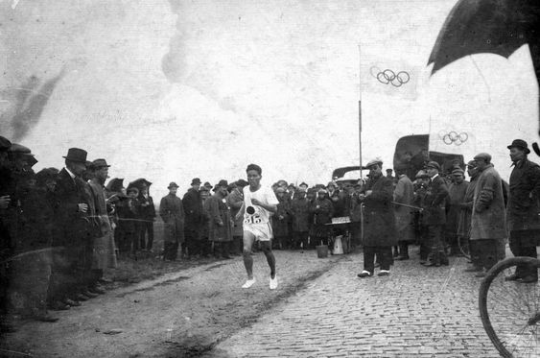
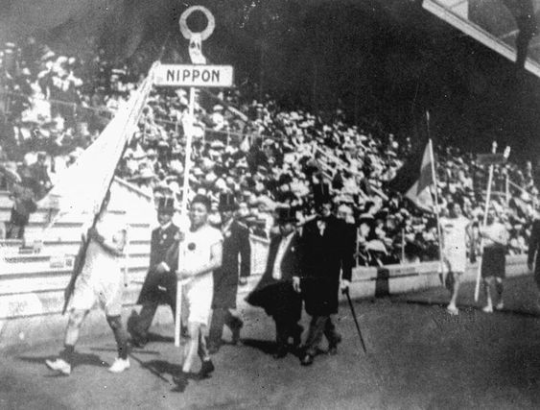
Have you heard the story of Mr. Shizo Kanakuri? He is regarded as Japan's “father of the marathon.” He so wanted to endure and complete the men's long distance race during the 1920 Olympic Games in Antwerp, Belgium. He was motivated to the max.
And he started out real well, but it got real hard and he fell out in a garden. There were 68 starters in that 1912 race, and just 34 would reach the finish line in the punishing conditions there. One Portuguese runner was hospitalized and died the next day, that was the first reported death during an Olympics.
Kanakuri was about two-thirds of the way through when he stumbled off course and fell into a garden area. Many reports then suggested that he passed out, perhaps because of a heat stroke, though others suggested he simply wandered into an outdoor party. Regardless, the race continued, and the Japanese runner found himself at a home on a farm along that race route. It was owned by the Petra family. The kind family fed him raspberry juice, fruits, and cinnamon rolls and gave him some new clothes and a place to sleep. He was very blessed, “He’d never run abroad before and was suddenly in a strange country and he had no idea what to do. So when the family offered to help, he simply took it.”
Kanakuri had to grapple with all the disappointment he felt from what had happened and the shame that was taking hold in his heart. He wrote in his journal the next day:
“It’s the morning after my defeat. My heart is aching with regret for the rest of my life. It was the most significant day of my life. But failure teaches success, and I can only wait for the day with fair weather after the rain so that I can clean up my shame. If people want to laugh, laugh. I showed the lack of physical strength Japanese people have and their immature skills. I can’t fulfill this burden but dying is easy, and living is hard. To wipe off this shame, I will work with all my strength to brush up my marathon skills and raise the prestige of our country.”
Race organizers, meanwhile, couldn’t locate Kanakuri. He never notified Olympic or Swedish officials of his whereabouts. He instead quietly left the country and returned to Japan. With his whereabouts unknown, authorities considered him to be missing, and urban legends grew around the country’s lost marathoner, many suggesting he had been running around the country for years, in search of the finish line.
It’s not clear why the Swedes couldn’t solve the curious case of the missing marathoner. He was hardly in hiding and resurfaced to compete at two ensuing Summer Olympics. He placed 16th at the 1920 Games but failed to finish the Olympic marathon in 1924.
The story of his disappearance started gaining attention around the 50th anniversary of the 1912 Games. The missing Japanese runner had become much more famous than any of the race’s medalists, a folk legend many were surprised to learn was alive and well in his home country.
In 1967, Swedish officials arranged for Kanakuri to return to Stockholm, where he was reunited with the Petra family and also invited to finish the marathon.
“When I went over to Sweden, I was surprised to find that he was very much more famous there than in Japan,” Sayama said. “Everybody knows about him for going missing.”
Guess what.. later on he came out of his hidden life and he even finished his race.
They held a ceremony, which was covered heavily in the Swedish media. When Mr. Shizo Kanakuri finally crossed the finish line, his time was announced as 54 years 8 months 6 days 5 hours 32 minutes 20.3 seconds — an unofficial time but surely in the running for slowest marathon ever.
You too can finish your race. You're called to Christ -- to know and worship Him. What specifically are you called to do by way of service for His glory? I say choose to endure to the end. Please start out with Christ, choose His pace and lead for you.. and He’ll indeed help you get over the finish line. Go for it.. go for Him. Hear His words, Well done!
What are some of the most well-known Bible verses about endurance?
God taught us believers (and is still teaching us) to stay with and totally loyal to Jesus through it all – He said no one having put his hand to the plow and looking back is fit for the Kingdom of God. Let not any sin, or idol, or pleasure, or money, or friend get in the way of your relationship with Christ. Will you endure in Christ until the end?
Paul instructed Timothy to keep on going in the face of trials. You therefore must endure hardship as a good soldier of Jesus Christ. What do I say when people ask me, hey Kurt, how are you doing?
I respond with, I’m holding my course or I'm soldiering on. Yes we soldier on but not by our own power, don't we? We keep going. Later Paul added to Timothy this..
“Remember that Jesus Christ, of the seed of David, was raised from the dead according to my gospel, for which I suffer trouble as an evildoer, even to the point of chains; but the word of God is not chained. Therefore I endure all things for the sake of the elect, that they also may obtain the salvation which is in Christ Jesus with eternal glory. This is a faithful saying: For if we died with Him, We shall also live with Him. If we endure, We shall also reign with Him. If we deny Him, He also will deny us. If we are faithless, He remains faithful; He cannot deny Himself.” 2 Timothy 2:8-13 nkjv
But hey, the Word of God is not chained.. not even in our day. Paul goes on..
"I suffer to the extent of being chained like a criminal. But the word of God cannot be chained! 10For this reason I endure all things for the sake of the elect, so that they too may obtain the salvation that is in Christ Jesus, with eternal glory. This is a trustworthy saying: If we died with Him, we will also live with Him. if we endure, we will also reign with Him; if we deny Him, He will also deny us.." 2 Timothy 2:9-12 (Always see the context)
Remember how James encouraged us all.. blessed is the man who endures temptation for when he has been approved he will receive the crown of life which the Lord has promised to those who love him.
Now, the Bible word for endure in Matthew 24 is a word which means to stay or remain, to lock your feet in place and not move. So the picture Jesus used to describe those who endure is those who are determined to stay under the load until Christ lifts the load. It refers to submitting to Authority, it’s a specific directive or command, it’s choosing to stay in a certain spot – in the will of God.
Even if others have moved on or have moved away, we are to hold on to the Lord. You might say that today while we're watching all the good values of our world being decimated we are not going there! We are to lockstep in the place with the Lord leading, yes in all we know is right from the Bible. No matter what else is happening wrong in this world, we shall not be moved in today's terminology.
We might say It's the person who hangs on to the end who shall be saved. That's not easy. It takes a lot of strength to hang on. We often think of endurances as passive, but it's not passive. I promise you it isn’t. Did you ever endure a lecture from a boring teacher? That's passive.
What about suffering through an all-night shift? In cases like that you just grin and bear it. That's passive endurance, but Jesus is not talking about passive endurance in Matthew 24. God is calling for Christian endurance and it's a command for Christ's followers to take a stand. Stand therefore! He wants us to stay standing--to push against the evil current and refuse to be moved, to hold firmly to Jesus and to God-given convictions. This adds to godly character and is a good witness.
Even when it seems like the whole world is against the believer, just Stand. Paul wrote to the earliest believers these words, He commanded us..
"Finally, my brethren, be strong in the Lord, and in the power of his might. Put on the whole armour of God, that ye may be able to stand against the wiles of the devil. For we wrestle not against flesh and blood, but against principalities, against powers, against the rulers of the darkness of this world, against spiritual wickedness in high places. Wherefore take unto you the whole armour of God, that ye may be able to withstand in the evil day, and having done all, to stand." Ephesians 6:10-13 kjv
What have you been standing for, or attacking?
Did you know that in the Bible there is no instruction for us to go attack. It's true. The instruction is for us to stand firm in the ground God has given to us. Yes, on the ground that we have in Jesus. We didn't get that ground ourselves. It was given to us by Almighty God. We aren't passive, but His blessings are free. He doesn't ask us to do anything except to stand strong and defend our territory.
There's no place in the Bible where we attack! We stand strong, and standing is a big challenge. Not as easy as falling or rolling off a log. You know why it's hard? Well, because we want to attack. Our fleshly nature wants to. Almighty God basically says, I want you to have the endurance and the strength and the courage and the steadfastness to believe what you biblically believe, to know what you believe, and to stand strong in that biblical belief.. no matter what anybody else is saying or doing.
Let others believe what they want to. Try to help em if you can. Some of it so crazy what people believe today. You wonder how any intelligent American can believe any of it--any of the fake news being shoved upon them? And yet, here we are in the strength of our stance. It takes stamina to stand, to walk in Christ, and to run the race before you.
Have you ever run across the Sahara before? Have you ever run in the Olympics or through any small or big desert. Guess what.. it'll takes some spiritual and physical stamina. That’s a word having to do with resilience. We believers are not only to merely endure, but we are to endure until the end with Christ.
Stand firm in the faith, yes, in what you rightly believe from the Word. Stand strong in Christ daily. Stand in what convictions He gave you, and in who you're committed to. In who you're called to. Don't be swayed or be flakey, or even wavering by all that's going on around you. Focus on Christ not on the circumstances. You don't have to attack. Just stand upright in Christ.. against the sin and this corrupt world system. Against the false messages, against the evil, and all wrong-doin’s. Stand strong in the One who stood for you. Act like real men, men! Act like real women, women. Enjoy your childhood, children (keep going towards Jesus and the Bible, boys and girls). We don't have to use our own strength to walk right, because we are to pray like the prophet Isaiah prayed in Isaiah 33:2 - in faith and then walk.
"O Lord, be gracious to us; we have waited [expectantly] for You. Be the arm of Your servants every morning [that is, their strength and their defense], Our salvation also in the time of trouble." Isaiah 33:2 amp
"But to us, O Lord, be merciful, for we have waited for you. Be our strength each day and our salvation in the time of trouble." Isaiah 33:2 tlb
Every morning pray in Jesus’ Name. Isn't that a great prayer from Isaiah? You can personalize it too. Lord Jesus, please be my strength today, yes, every morning. We can claim Isaiah's promise for those who believe, and who wait on the Lord. They shall renew their strength. For those of us living in the world of the end Jesus' words are called to keep on going with Him as Lord.
As the signs of the times are exploding around us we’re to run through the smoke, we're to run through the trembling earth, through the loud, churning, spinning battlefield and through the agitation of our age. We’re to run back to Jesus. We cannot stop until Jesus comes. We are called. This highway of holiness, this road of righteousness is a road that has no off-ramps in sight. It's a road straight to where God has called us..each of us to be.
The Apostle Paul said, "I do all this for the sake of the gospel, so that I may share in its blessings. Do you not know that in a race all the runners run, but only one receives the prize? Run in such a way as to take the prize. Everyone who competes in the games trains with strict discipline. They do it for a crown that is perishable, but we do it for a crown that is imperishable." 1 Corinthians 9:23-25
"And Jesus answered and said to them: “Take heed that no one deceives you. 5 For many will come in My name, saying, ‘I am the Christ,’ and will deceive many. 6 And you will hear of wars and rumors of wars. See that you are not troubled; for all these things must come to pass, but the end is not yet. 7 For nation will rise against nation, and kingdom against kingdom. And there will be famines, pestilences, and earthquakes in various places. 8 All these are the beginning of sorrows. 9 “Then they will deliver you up to tribulation and kill you, and you will be hated by all nations for My name’s sake. 10 And then many will be offended, will betray one another, and will hate one another. 11 Then many false prophets will rise up and deceive many. 12 And because lawlessness will abound, the love of many will grow cold. 13 But he who endures to the end shall be saved. 14 And this gospel of the kingdom will be preached in all the world as a witness to all the nations, and then the end will come." Matthew 24:2-15 nkjv
It’s fun to check out the original Greek language in God’s word with some good helps. The word “you” can be either plural or singular when we see that word “you” in our English books, and sometimes we don't know what to think when we hear people speak this word.. until we see the whole context. But in the Greek language “you” can tell us how the Greek language is different from English.
For instance, Jesus used the plural “you” in these verses above (in Matthew 24). When you go through this text you'll understand what I'm saying about this here. Jesus was sometimes using “you” in the plural in Matthew 24. "..Jesus answered and said to them: ‘Take heed that no one deceives you’”. He's talking to the group here in Matthew 24:6, “you” plural will hear of wars and rumors of wars. See that you plural are not troubled. This is the plural “you” here, and then Matthew 24:9 "Then they will deliver you up to tribulation and kill you, and you will be hated by all nations for My name’s sake.” but then there's a shift in Matthew 24:13 and it's a wonderful shift too. The word translated he in that verse is not plural but singular, "But he who endures to the end shall be saved.”
Do you like that? We don't endure as a group regarding this, we endure as individuals. The “you” here is singular, Jesus said but “you” singular endure to the end--and you singular will be saved. Jesus spoke to you and to me as individuals, he was encouraging each of us to hang in there and keep on hanging in there ..keep on walking standing in faith. Keep waling in victory for as long as it takes. Yes, enduring as a follower of Jesus requires not only strength but also perennial personal stamina.
So don't be afraid to go the distance with God as he empowers you. Take your stand for the Lord and what you know is right. Study what God has communicated through His word and then keep standing no matter what comes your way. Simply remain steadfast until the end by His power for His glory. Yes, it does indeed take determination every single day. We need Christ every moment of every day.. until the end! We are saved by faith for free, and then we follow Christ all the way home to heaven.
Are you into endurance? Charlie Engle is and he talked about his own endurance mission: Running across the Sahara Desert.
That’s what he did. Yes, Charlie Engle was no stranger to a great challenge. The 46-year-old endurance runner turned his life around from being a drug and alcohol addict to living sober since 1992. He refocused his addictive personality toward running, and eventually toward entering marathons, then into ultramarathons – adventure races, endurance missions. His latest was: Running across the Sahara Desert. In February, 2007, Charlie and his teammates Ray Zahab and Kevin Lin became the first people in all of history to run across the entire Sahara Desert, covering over 4,300 miles in what became a 111 consecutive day effort.
There was a movie documenting their great feat, "Running the Sahara" (produced by James Moll and narrated by Matt Damon). It's an incredible summation of what was surely one of the most difficult running challenges anyone's ever set out to go for. Charlie then became a motivational speaker and a television producer, at the Big Sur Marathon where he was showing "Running the Sahara" and running Big Sur for fun (clocking a cool 3:25 on the course). Where did the idea to run across the Sahara come from? Kevin, Ray and I were racing against each other in the Jungle Marathon, a 125-mile race through the Amazon at the end of 2004. Ray had just done the Trans 333 in Niger [a 333-kilometer race]. He loves the desert, and said to me, "Hey I don't think anyone's ever run across the Sahara, are you interested?" And I was like, "Ya, sure!" We both found no evidence of anyone ever doing running it before, something that's almost unheard of in this day and age because people are always tackling the next big thing. I mean, I've joked about doing Badwater on a pogo stick with my arms tied behind my back, just to be the first person to do it. But running across the Sahara—that was a pretty straightforward thing. We estimated it would be about 3,000 miles, but it ended up being a little over 4,600 miles. The maps and details just don't exist. How did it then come together?
I'll be honest, I never actually believed it was going to happen. It started as one of those crazy ideas that you get to take ownership of, but the reality usually is that it's probably never going to happen so you don't have to worry really about it. We did a scouting trip in October, 2005. I had been so focused on the planning, getting the sponsorship dollars and everything, that I kind of forgot about the physical aspect of it.
Then one day I had James Moll and Matt Damon involved in the project. I woke up one morning about five months before we left and said, "Oh shit. I actually have to run across this desert." So how did your training change? Ray is a personal trainer—that's his background, so I let him create the program. I do almost everything based on time instead of mileage, but my training really picked up an incredible amount. I reached a point where I was running as much as 25 and 30 hours per week. At a 10-minute pace (I'd normally be running faster than that), I was doing 200-mile weeks at a minimum for about four months. Before that, getting ready for races like Badwater, I was probably running half of that ... like 10-12 hours a week. More than anything else I needed to be able to get up and do this day after day after day. Ray had me doing back-to-back days of four-hour runs, three to four days in a row. A couple months before we left, I did 10 days in a row running four hours a day. And what about your nutrition while training, and then during the expedition?
I had to adjust the nutrition leading up to the run. I tried to teach my body how to eat and process 5, 6, 7,000 calories a day. Your body would just shut down if you tried that right away. Here in the U.S. I ate anything I could get my hands on, like chocolate cake and ice cream. I ate everything and anything I wanted for the month before we left for Africa. I gained 10 extra pounds, even with all the training.
But immediately when we got to Africa, it was obvious we wouldn't be able to keep that up, due to what was available to us. We consumed 2,000 calories a day in Gatorade, 3,000 calories in food. I needed more like 8 to 10,000 to maintain my weight. It was rough. There's no refrigeration there, so the goat in the back of the truck in the morning is in the pot in the evening. That was really distressing to me. I had to say to our cook at one point that I just could not eat any more couscous, any more goat. We got camel meat a few times, and that tasted better. You lost a considerable amount of weight, right? I lost nearly 40 pounds at the maximum. The interesting thing is that I gained seven or eight pounds back in the last few weeks. My body reached it's tipping point, and started holding on to the food. My metabolism adjusted. How much walking did you do?
We kept track of all of it on GPS, and were averaging under 10-minute miles for the whole run. We only walked about one percent of the total (50 miles or so of the whole amount). We'd walk in the morning for 15 minutes, start our morning in the dark talking into tape recorders audio journal. I recognized that no other way would we have the energy to journal during these days, so this is how we documented our thoughts and feelings. How is it going through those journals now, in retrospect?
I am shocked at how much detail and how deep my thoughts really were. Actually, my level of anxiety is what really shocks me. At those times, talking to myself, I was really full of anxiety. I felt really responsible. I had dragged five other people and about 20 camera crews and native Tuaregs out here, and I was thinking, "This is a disaster." I genuinely felt I had hoodwinked all these people to come out to the desert. I was desperate. I didn't tell Ray or Kevin. All I said every day was, "Everything's going to be fine." Meanwhile, I'm thinking, "Oh my god, are we going to survive this? Are we going to get across this desert?"
I admit that ego came into play. It was like, "This is going to be so embarrassing if we're back home in a couple of weeks. I'll never get another sponsor, no one will ever listen to me." Anything tremendously physically challenging can leave you feeling raw. So how did that play out?
There was no buffer zone. Any emotion I had basically happened real time without any holding back. Sometimes that was really funny. We had some incredibly moving moments. There were times where we're all three in tears ... while we were running through villages and these kids are coming out to see us, or we'd be crying because we got some really good cookies and we were so grateful about it. It's amazing what small things would really make our day. I took everything personally. I took it to heart when something didn't go well, like if we didn't have enough food or water, or if the truck got a flat tire. I felt like everything out there was my responsibility. What part of your body hurt the most? I had tendonitis in my right shin, like a shin splint on steroids. That scared me the most. Ray had the same thing. Tendonitis doesn't go away, especially while you're trying to run 50 miles a day. On the last day, I had a horrendous staph infection going on within this blister on the bottom of my foot. While running, it burst. It was gross, and I felt it squishing around, but it relieved so much pressure that I could actually run. There's some controversy insinuated in the film on that last day, making it look like you were trying to leave your teammates when you felt good. What do you say about that?
It is the craziness of an expedition to think that I would ever leave them. It became their fear. I think the thought manifested in them that it was something I might do. But, look, I'm a TV producer by trade. I knew without having to be told that we needed to finish in daylight. I knew that the last thing I wanted to do was spend another night out there so I could run the last five miles in daylight.
My blister popped, and I started running again, knowing they'd catch up. But showcasing it like I would try to leave them creates a little more intrigue. Then you guys made it all the way! Are you surprised you guys made it? You all had to adjust to the changing circumstances.
Every single day I woke up as expedition leader, I said, "Ok, here's our plan." Not one time did it ever go anywhere close to as planned. We did not have many good days out of those 111 days. Eleven of them, at most, were what I would call healthy days where not one of us was in distress. We'd run out of food, water, get lost, have a fight, someone would have hurt feelings. It was incredibly rare that something didn't impact how we progressed. It was all about how we would adapt. It was almost just two of you finishing, and not three. Why?
Kevin wanted to quit. He's younger, and there were many, many days where we were running along with no purpose, where we might have been going in the wrong direction. We truly ran for two weeks between Niger and Libya when we didn't have any idea if we were going to get to continue if Libya wouldn't let us in. It's like knowing there are layoffs, and your boss asks you to start a new project. We had to get up and run 50 miles every day without knowing if we were going to be able to continue. I convinced Kevin that we had to keep trying as hard as we could. It's something I learned from adventure racing. Don't ever pull yourself from the course. Go until you couldn't go, because something might change, the cutoff times or rules or whatever. You keep going.
I even had a crazy plan that, if Libya didn't let us in, we were going to run up to Algeria, Tunisia, see if we could find a ship, run around the deck in a circle while the ship sailed around Libya and then get off and finish. They thought I was crazy, but I was totally serious.
Charlie said, “I wasn't going to live the rest of my life wishing we went as far as we could.” The team endured and the finished. You too can finish right--think well, and pray about it.